no rotate image set no rotate image set no rotate image set no rotate image set

Summer Posters

Posted by: roy-lagemann | September 22, 2009 Comments Off |

At the end of our time in the Karnovsky lab this summer, Kristen and I created Posters displaying some of the preliminary data we analyzed since our trip to the Channel Islands. Kristen’s beautiful poster, titled “Murrelets on the Move: Seasonal Density of Xantus’s Murrelets near Santa Barbara Island,” discussed how the distribution of XAMU around SBI was affected by surface water temperature, and how both distribution and temperature changed between April and May. Kristen found that surface temperature was significantly cooler in April than in May. She also found that XAMU prefer the colder water to the west of SBI, possibly because of the higher abundance of prey (something we hope to confirm this semester).

A figure from Kristen's poster

A beautiful figure from Kristen's poster

My poster was titled “Changes in At Sea Distribution of Xantus’s Murrelets Since 1976,” and it focused on the differences in XAMU counts and distribution between our data collected this year, and data collected in the same months in 1976. I found that XAMU numbers were much higher in 1976 than in 2009, and that XAMU were found in larger numbers along western transects in both months and in both years.

A figure from Augie's poster

A figure from Augie's poster

This semester, we will continue to look deeper into how the physical traits of the water around SBI affect the XAMU distribution during breeding months. We will also soon begin to analyze the distribution of zooplankton around the island and how it affects XAMU distribution. There is still a lot of analysis to be done!


Filed under: Channel Islands
Tags: , , ,

The Last Banding

Posted by: charlotte-chang | August 17, 2009 Comments Off |

The MAPS (Monitoring Avian Survival and Productivity) protocol has a set range of dates for bird banding. As I stated before, in the last few banding periods (periods 8-10 to be specific), juvenile birds should predominate. MAPS has the overall goal of assessing survivorship and breeding rates of resident birds, and as such, its protocol asks mist net operators to note birds that are potentally transitory migrants (lest they skew our survivorship estimates). Therefore, we should catch a larger proportion of young birds near the end of the season because they are beginning to be active, and the vast majority are preparing to migrate.

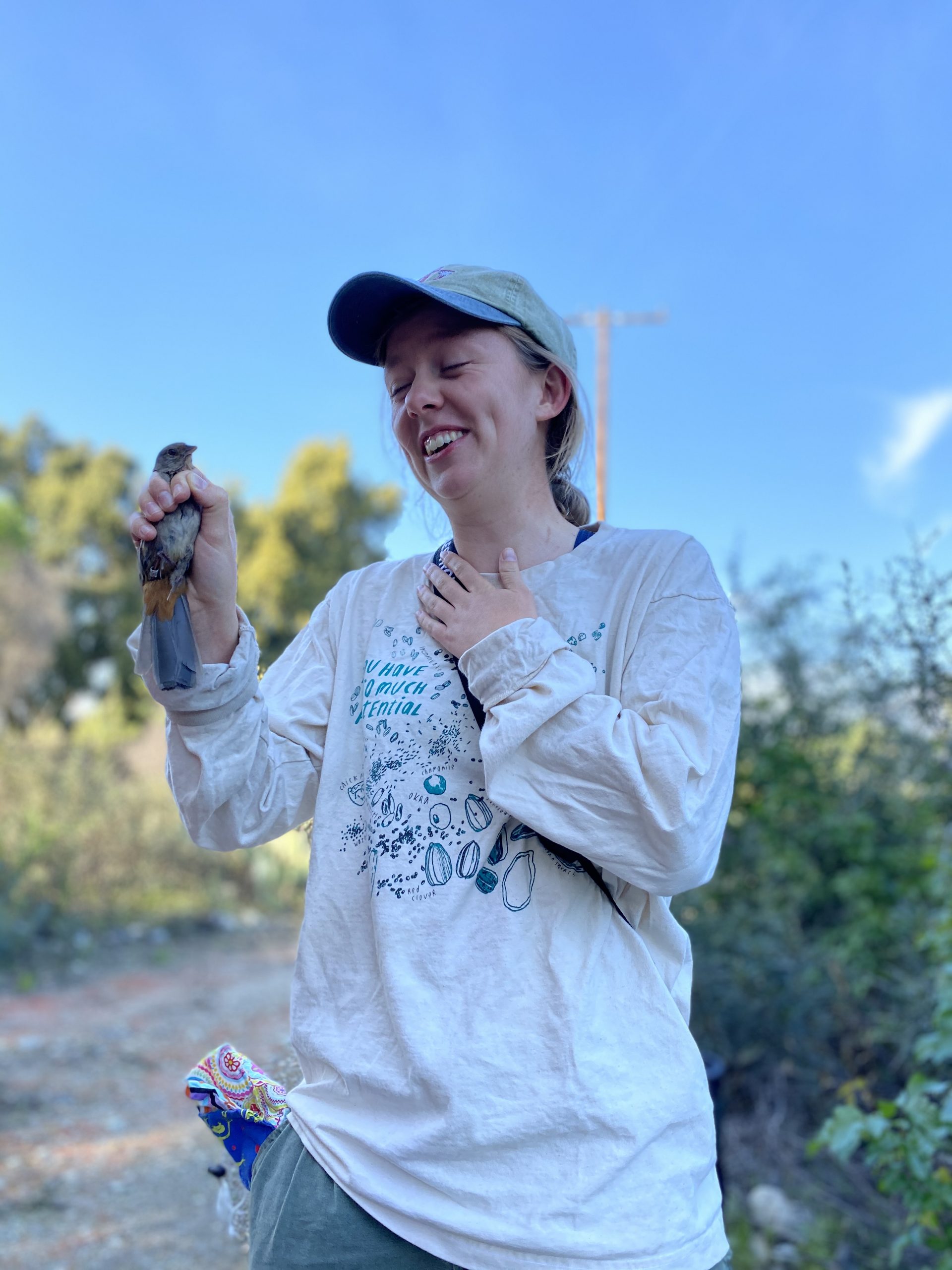
Our last banding day was Friday, 8/7, and we caught a total of 32 birds which was quite remarkable. In addition, most of the birds we caught were juveniles, with two exciting new catches—our first clay-colored sparrow (which was incidentally a juvenile), and a just-feathered hatchling yellow warbler that looked as though it had fallen out of its nest and into the net!

Amy holding a Yellow Warbler.

Amy holding a Yellow Warbler.

Lee Cornwell, one of the owners of this beautiful grassland ranch, graciously allowed us to ask him a few questions. In college, his major introduced to him a rotational grazing system that he and his brothers believed would be better for the land. Currently, all of his pastures are on a rest/graze system, where they are rested for months or even years between grazings to allow the plant community to recover.

He and his family have a deep commitment to sustainable use of their land, and he hopes that future generations of Cornwells will continue to graze their land wisely so that the flora and fauna associated with their ranch can continue to florish. He has taken remarkably good care of his ranch and holds a deep knowledge of the local landscape. We thank Lee for his hospitality, for allowing us to use this land, and  forthe wonderful care he has paid to this landscape.

Lee Cornwell standing outside his home. Thank you Lee!

Lee Cornwell standing outside his home. Thank you Lee!


Filed under: Prairie
Tags: , ,

home, home on the range

Posted by: amy-briggs | August 9, 2009 Comments Off |

Last Wednesday, Charlotte and I finally got to go out with range management. These guys do a lot of habitat surveys and such, and the day we went out was no exception. First were some riparian habitat assessments, where we walked in and around dry stream beds to determine if the waterways were in “pfc”, proper functioning condition. The first part of the pfc assessment is taking a photo from a stake that somebody put at the site a long time ago– the idea is to be able to compare these photos, taken from the same location, to see how the site is changing over time. Then we would walk around and look at things like sinuosity (i believe this is a measure of how meandering the stream is, but i think its a little more complicated than that), evidence of downcutting, bank stability, riparian plant communities, and flow capacity. If they decide a waterway isnt in pfc, they have to make recommendations about how to fix it, so they also have to take into account its potential– for example, one of the sites we visited wasnt in great shape, but there wasnt a whole lot that could be done about it because its flow had been restricted by upstream dams. It was concluded that this site had reached its potential and was therefore in pfc.

Riparian habitat assessment. This is a good-lookin stream bed.

Riparian habitat assessment. This is a good-lookin stream bed.

After we finished with the riparian assessments, we drove to another site to do an upland habitat assessment. We surveyed a vegetation plot that nobody had looked at since 1989, dug a hole to look at the soil, and compared the plant communities present to the ones that “should” be present according to the big binder of range management stuff. Turns out this spot was not in great shape; after being homesteaded and farmed in the 1930s (and later vacated), club moss and three awn grass grew back in. The club moss is particularly problematic, because it covers the ground, hinders percolation and blocks other grasses from growing in. The result is that the land isnt as productive as it could be in terms of livestock, because cows dont eat club moss. The two ways of getting around this “dead end” succession pattern are fire and tilling (with a plow or a herd of buffalo, but since there are no buffalo…), neither of which can be enacted easily by the BLM, so for now the club moss reigns supreme.

Steve, Ray and Tom. They are amazed at the amount of three awn we found in this plot.

Steve, Ray and Tom. They are amazed at the amount of three awn we found in this plot.

Tom digging a hole to see the soil layers. The topsoil here is very deep. Part of the assessment asks the soil type, which you decide by taking a handful of dirt and getting it wet. If you can make a long ribbon of mud between your thumb and forefinger, the soil has a high clay content. This soil was just silty, but we still got to play with mud, which was cool.

Tom digging a hole to see the soil layers. The topsoil here is very deep. Part of the assessment asks the soil type, which you decide by taking a handful of dirt and getting it wet. If you can make a long ribbon of mud between your thumb and forefinger, the soil has a high clay content. This soil was just silty, but we still got to play with mud, which was cool.


Filed under: News, Prairie

Glasgow’s michelangelo

Posted by: amy-briggs | August 1, 2009 Comments Off |

A little background: Most of the days during the week Charlotte and I drive to our MAPS station to do habitat surveys, bird censuses and banding. To get there, we turn right on the big main road, drive for a long time, turn right on the cornwell ranch road and navigate a confusing network of gravel roads and two tracks to get to our creek. Within the first 2 minutes of our drive while we are still on the main road, we leave Glasgow. On the outskirts of town, we see some hills on the right. On top of these hills are these mysterious creations:

Mystified? So are we. What we have managed to learn about these things can be summarized as follows:

-The guy who makes them is named Buck Samuelsen

-He sells them

-Someone in Glasgow bought one (its outside a store)

-They are made of old oil drums and other scrap metal

In any case, they are a cool addition to the scenery along highway 2. Hooray public art installations!


Filed under: Prairie

Loose Ends

Posted by: eleanor-caves | July 31, 2009 | 1 Comment |

Well, today is my last day on the Farallon Islands, and I honestly cannot believe that the last eight weeks has gone by so quickly. I’ve spent today tying up loose ends, packing, and doing my various studies–rhino daily checks and PIGU breed.

Tomorrow, Hannah and I will be boarding “Mi Vida,” a 42′ sailing yacht whose skipper is a member of the volunteer Farallon Patrol, and heading out to Alameda, where the boat docks.  Then we will unload all of the trash and recycling from the island and drive up to the PRBO offices to finish cleaning things up.

In some ways, I am ready to go home–I want to eat ice cream, see Harry Potter, little things like that.  In other ways though, I know I’m really going to miss this place.  Just two days ago, for example, twelve Humpback Whales parked themselves in Fisherman’s bay and proceeded to feed en masse for over an hour.  Watching animals that huge and that close is an amazing experience.  This whole island is an amazing experience, and I am truly fortunate that I got the opportunity to come here for so long, to work with the people (and the animals!) here, and to see all the things that I have seen.  It has been the greatest experience of my life, and certainly a formative one.

The forecast tomorrow is for smooth sailing, so I can only hope the weather holds.  By tomorrow evening, I will be back in civilization, dealing with traffic, waiting in line, and other people.  It certainly will be different!

Well, that’s all for now.

Best,

Eleanor


Filed under: Farallon Island

A river runs through it

Posted by: charlotte-chang | July 30, 2009 Comments Off |

This morning, Amy and I went prospecting for another potential MAPS site. John suggested that we find a site both closer to town (obviating the need to wake up obscenely early to get to a far-away site by dawn), and closer to the major river to compare avian community composition at varying distances from a permanent running water source.

The main river here is the Milk River, so named (at least I think) because of its opaque—i.e. milky—color and quality. It’s a slow-moving river, so it makes for fantastic invertebrate breeding grounds, and as such, attracts many flycatchers and other insectivores. We chose to go to Faraasen (alternatively spelled Faraason) park, a tract of public land lying adjacent to the Milk.

We saw our first Belted kingfisher of the season at the park. Based on the rusty flanks and triangular patch on the upper breast, we identified it as either a female or a juvenile. It was perched close to the water, and when we approached, it quickly flew away. It has a magnificent crest and striking coloration. (A picture of a kingfisher in flight can be found here, courtesy of the National Parks Service: http://www.nps.gov/prsf/naturescience/images/belted-kingfisher1.jpg.)

We also saw quite a few (>10) bank swallows throughout the park and perched on telephone wires running through the grassland flanking the park. They are North America’s smallest swallow (according to David Sibley), and they were being hassled by two very bold Eastern Kingbirds. Amy and I have noticed that the Eastern Kingbirds around here have a fairly outgoing or foolhardy/courageous personality for they will perch and call very loudly, content to not fly away until you are within 5 or less feet of it. Charles Carlson—John’s father—has some great pictures of bank swallows here: http://www.pbase.com/mccownii/image/115477782 and here: http://www.pbase.com/mccownii/image/115477741.

All in all, this site was very productive, and it certainly appeared to have a higher proportion of insectivores. With any luck, this will be a MAPS station in 2010!


Filed under: Prairie
Tags: , ,

The Great Spinach Battle

Posted by: eleanor-caves | July 28, 2009 Comments Off |

The Farallon Islands, like almost every island that has experienced human presence or traffic, have a pretty serious problem with invasive plants.  The worst of these invasives, by far, is the New Zealand Spinach.

A Close-Up of New Zealand Spinach

A Close-Up of New Zealand Spinach

New Zealand Spinach is a spinach, as in, you can eat it, but the one time it was ever served out here, I hear it was awful–really salty.  However, a recent report on NPR which focused on “urban scavengers” did include an interview with a guy who claims it’s really tasty.  Well, maybe, but at least not out here.  In addition, the spinach is a really awful, annoying plant.

As you can see, it’s a very dense plant, and it’s dense root-structure interferes with the ability of burrowing birds (out here Cassin’s Auklets and Rhinocerous Auklets) to build their burrows.  In addition, it chokes out the Farallon Weed, the main endemic plant out here.

Spinach Seeds

Spinach Seeds

The war against spinach is somewhat of a Catch 22.  Around this time of year, the end of July, the spinach plants go to seed, each one dropping hundreds of tiny seeds.  Once a plant has seeded, it’s almost not worth trying to pull it up, because the damage has been done.  So, then, it seems that the obvious thing to do would be to try to pull the spinach before it seeds, possibly even as early as June.  The problem with this plan is that so many of the areas on the island are completely off-limits in June.  Pulling spinach would cause immeasurable damage and disturbance to the breeding seabird populations, so there’s almost no way to keep a lot of the plants from dropping seeds.

Before I continue my story, one thing you have to understand is that the entirety of Southeast Farallon Island is a wildlife refuge.  There are, however, wilderness areas on the island that pretty much no one is allowed into.  One of these wilderness areas, over by North Landing, hasn’t been visited by PRBO staff for probably around 20 years.  This year, however, we’ve noticed from far away that a lot of large mats of spinach were cropping up in the area.  So, we got permission from the refuge manager to head over there and pull the spinach.  This turned out to be very complicated.

First of all, getting to the area would be simple, except for the fact that a bunch of Pelagic Cormorant nests sprang up right in the clearest path to the area, so we couldn’t go that way.  Instead, we decided to take the long way around, up Lighthouse Hill, down the ridge, across a couple of other ridges, and into the wilderness area.  This is a LONG, DIFFICULT, and relatively dangerous path, since for the majority of it you’re creeping along cliff faces trying not to dislodge the mixture of loose rocks and gravel (”scree”) that make up the body of Lighthouse Hill.  In addition, Fish and Wildlife protocol stated we had to bleach our shoes before heading over there, AND we had to bring all the spinach we pulled out in bags.  (Normally, when we pull spinach, we just turn it upside down on a rock and let it dry out.  Not this time though.)

Me Sitting on a Mat of Spinach

Me Sitting on a Mat of Spinach

It took about half an hour to walk over to the wilderness area, and once there, a couple of hours to pull all the spinach.  Lots of the plants were in huge mats, with individual plants weighing around twenty pounds once we pulled them.

In addition to pulling the plants, we spent some time picking seeds out of the dirt, but this is a pretty hopeless task, since there’s no way we’ll ever get all the seeds.  Every little bit helps though!

Bags of Spinach

Bags of Spinach

Ultimately, we ended up with eighteen contractor bags full of spinach.  Limited by the number of bags we had brought, we stuffed them all very full, and each of them easily weighed between forty and fifty pounds.

Remember when I said that the trip over to the wilderness area was difficult?  Well, to put it mildly, it was NOT easier when lugging a forty pound bag of spinach on your back.  We ended up sort of daisy-chaining the bags as frequently as we could, passing them along from flat area to flat area.  Sometimes, though, we just had to buckle down and lug them fairly long distances with nowhere to stop.

Bringing Up the Bags from our Last Stopping Point

Bringing Up the Bags from our Last Stopping Point

The spinach work ended up taking about five hours, all afternoon, and left everyone more exhausted than I remember being since I got here.  Good thing I’m not cooking tonight!

Anyway, I can’t believe I’ve only got three days left here.  Over the next few days, I’ll be transferring my studies over to other people, to continue until they conclude.

Well, Hannah’s making thai coconut soup tonight, which is smelling delicious, and we’ll probably watch a movie tonight, since Rhino netting ended last night.  No night work tonight!!

That’s all for now.

Best,

Eleanor


Filed under: Farallon Island, News

ice ice baby

Posted by: amy-briggs | July 27, 2009 | 1 Comment |

This weekend, Charlotte and I finally made it out to Glacier National Park! Glacier is a spectacular place– if you’ve never been, I highly recommend it. Early on Friday morning (~7am) Charlotte, Lauren and Marisa (BLM summer interns) and myself were jamming ourselves and all our gear into Lauren’s subaru. Before we truly began our journey, we had to stop in Malta to pick up Spencer, another BLM intern who was coming with us. After we picked up Spencer we drove for another 5-6 hours across the prairie until the mountains popped into view. We went to the gate on the road to Many Glacier, a campsite recommended to us by a co-worker, but by that time it was already midafternoon and this popular campsite was full. We drove around and found ourselves another spot at Sun Point, pitched our tents and went out for a leisurely afternoon stroll to some local waterfalls. We walked about 4 or 5 miles and saw three waterfalls, an elk a mule deer (thanks john), and a chipmunk trying frantically to cover up a hole it had made in the middle of the trail while we stood about three feet away. Charlotte also found a caterpillar at war with some ants.

The elk. We saw it on the trail, and it ran up into the trees to go around us and then got back on the trail behind us.

The mule deer. We saw it on the trail, and it ran up into the trees to go around us and then got back on the trail behind us.

St. Mary's falls-- very impressive.

St. Mary's falls-- very impressive.

The caterpillar. Two ants are trying to carry it away, probably to become dinner.

The caterpillar. Two ants are trying to carry it away, probably to become dinner.

On the second day, we undertook a hike which would take us up to a lake, and which had an optional spur to a nice lookout through a tunnel. On our way up to the first lake (aptly named iceberg lake) we came across some fresh, still-wet bear (grizzly??) poop on the trail. I checked it out, and determined that it definitely had fur in it, along with what might have been berries and sticks at some point. Before starting our hike, we sprung for some bear spray ($45), but still we preferred not to run in to one.

Bear scat. Cool.

Bear scat. Cool.

We continued our journey, unfettered by bears, and saw some very cool flowers.

wildflowers. The red one on the right is red (or possibly pink) paintbrush. There are a couple of different colors of paintbrush, and we discovered on our hike that there is an ecotone that divides where lemon paintbrush and red paintbrush grow. The reds grow at lower altitudes, the yellow at higher, though their is some overlap.

alpine meadow wildflowers. The red one on the right is red paintbrush. Red paintbrush grows at a lower altitude than lemon paintbrush, but there is a zone where their ranges overlap, called an ecotone.

Beargrass. Apparently it is neither eaten by bears nor a grass. The early pioneers just named it this because they sometimes saw bears near it.

Beargrass. Apparently it is neither eaten by bears nor a grass. The early pioneers just named it this because they sometimes saw bears near it.

At last we arrived at our first destination, iceberg lake!

Iceberg lake. Very cold to the feet.

Iceberg lake. Very cold to the feet.

Charlotte, Lauren, Spencer and I decided that we wanted to keep hiking, and we headed off towards ptarmigan lake. We decided not to go all the way to ptarmigan tunnel because we had just made up our minds to hike to do a long hike to a glacier the next day, and we wanted to save our feet. It turned out that ptarmigan lake was nothing to write home about, but we did see some cool wildlife, including a marmot and a butterfly that landed on my hand.

This marmot was extremely habituated to people. It walked right by us, and munched on some veg less than 30 feet away.

This marmot was extremely habituated to people. It walked right by us, and munched on some veg less than 20 feet away.

Butterfly.

Butterfly.

After our hike that day (~13miles), we were tuckered out, so we decided to just drive around and check out the park. We drove up to logan pass and saw some mountain goats and bighorn sheep.

mountain goats in a parking lot near logan pass.

mountain goats in a parking lot near logan pass.

That night there was a ferocious thunderstorm, but it could not keep us awake, especially after the day we’d had. The next morning we were up bright and early again, hiking by 7:45 to see Grinnell Glacier. As far as we could tell, this 5.5 mile hike (11 round trip) is the shortest hike to a glacier in the park. There is an interesting little display at the trailhead with photos of the glacier over the past hundred years and some information about climate change. The hike was beautiful and not too too strenuous, with nice views of the glacier and a few lakes the whole way up. We also had to walk through a waterfall to get there and back, which was refreshing in the 80 degree weather.  This glacier is enormous (or so it looked to me, but perhaps it isn’t compared with what it used to be) and is definitely the biggest chunk of ice i’ve ever seen.

Spencer on the other side of the waterfall.

Spencer on the other side of the waterfall.

Nice view on the way up to the glacier.

Nice view on the way up to the glacier.

Grinnell glacier. Note Marisa for scale.

Grinnell glacier. Note Marisa for scale.

The group (minus Spencer, he's taking the photo) at Grinnell Glacier.

The group (minus Spencer, he's taking the photo) at Grinnell Glacier.


Filed under: Prairie

a Flicker of a catch

Posted by: charlotte-chang | July 27, 2009 Comments Off |

Last Wednesday (8/22 to be more precise) was our second to last banding day. The Institute for Bird Populations (IBP) which is the entity overseeing all MAPS banding stations stated that in periods 8 – 10, the young of the year will predominate in the catch. What this means—or should mean—for us is that we should be catching a higher raw amount (and most likely a higher proportion) of hatchlings.

In banding session 9, however, we only caught 2 hatchlings out of 14 captures. We’ve exceeded this capture rate of young in past sessions. What is notable though is that we are starting to see different species, and particularly, different species caught that are hatchlings.

We caught our first Northern Flicker that day, and it was also a juvenile (aka hatchling, young of the year, etc). Our first capture of a juvenile Brown Thrasher also occurred on that day. Earlier in the season, the majority of the juveniles captured were House wrens, with a few Western meadowlarks, and one juvenile Eastern Kingbird. All of the aforementioned birds are smaller (especially wrens), and thus our increased capture of larger birds in general, and larger juveniles in particular, could be an artifact of a longer time requirement to maturation.

John looking on at the juvenile Northern Flicker (a type of woodpecker). It was extremely feisty!

John looking on at the juvenile Northern Flicker (a type of woodpecker). It was extremely feisty!

In addition, the composition of birds that we’ve observed on our censuses and caught during banding runs has gradually been changing. Early in the season we observed a fair amount of shorebirds within the Cornwell Ranch property in its entirety and within the MAPS station itself. The shorebirds have mostly moved on by this point, having begun their arduous trek to their wintering grounds. We’ve been catching more and more larger birds and fewer flycatchers, in general—the exception being the Least Flycatcher that we caught last week, which was also our first catch for that species.

A disgruntled-looking Least Flycatcher.

A disgruntled-looking Least Flycatcher.

A loggerhead shrike that we saw en route to our site. It was our first sighting of this species, and they are carnivorous birds that immobilize and kill their prey by slamming them onto buffaloberry spikes, fence posts, etc. In fact, the plant it is on is a buffalo berry. It has undergone drastic declines in its abundance.

A loggerhead shrike that we saw en route to our site. It was our first sighting of this species, and they are carnivorous birds that immobilize and kill their prey by slamming them onto buffaloberry spikes, fence posts, etc. In fact, the plant it is on is a buffalo berry. It has undergone drastic declines in its abundance.

We’ll keep you posted on our tenth and final banding run, and if you see a killdeer at a southerly shore nearby, please say hi to it for us!


Filed under: Prairie
Tags: , , ,

My Room, and Stuff

Posted by: eleanor-caves | July 25, 2009 Comments Off |

Well, it’s been a few days so I thought I ought to update about what’s been going on.  The last four or so days have been pretty odd–as I mentioned, the majority of the seabird work is drawing to a close, so we are left with a lot of odd jobs and data entry/proofing.  One might think that this would make the time drag, but it’s been just the opposite.  Despite the fact that I spent at least three hours a day for the last five days repairing mistnets, the time has flown.  I can’t believe it is already Saturday!

Saturday out here is chores day.  Seeing as there are six of us, there are six chores.  I’ll list them here for posterity: (1) Bathrooms–pretty self explanatory, just clean the bathrooms; (2) Floors–sweep and mop the entire house, pretty time-consuming; (3) Kitchen–this is the most labor-intensive job, involving cleaning out all three of the refrigerators and disposing of old food, cleaning counter tops, cleaning out the stove/oven, and basically anything else that needs doing in the kitchen; (4) Windows–between salt spray and bird guano, the windows get pretty dirty, so the windows get washed every week, at least the downstairs ones (with the upstairs, the washing is a little more sporadic); (5) Shoe Room/Tidy Up–Clean the shoe room and tidy up all over the house; (6) Compost/Recycle/Trash/Burn/House Laundry–basically, take care of all the waste.  Burn what can be burned, compost what we attempt to compost (although it doesn’t really get warm enough out here to work), place recyclables in action packers to be taken on the next boat, and then do all the communal laundry (sheets, napkins, dish towels, etc.).  Chores aren’t so bad, especially when the days aren’t too busy.

Mostly Feathered Rhino Chick

Mostly Feathered Rhino Chick

Today was also a five-day Rhinocerous Auklet chick check, meaning we went around to all of the inhabited boxes (the official deadline to stop checking empty boxes was only a few days ago) to weigh chicks, take wing cord measurements, and band any that are now big enough.  A few rhino chicks, like this one at left, are now mostly feathered, and big enough to band.  You can just see how the sleek black feathers on his face are starting to replace his fluffy down.  Very cute.

Banding rhino chicks means there are now some rhinocerous auklet daily checks, which have replaced my Cassin’s daily checks.  Only yesterday, my very last Cassin’s chick fledged, and so daily checks have finally stopped.  It feels weird not doing them, since I’ve done them every day since the second day I got here.  Also, last night we started our last round of rhino netting, so we’ll have nightwork for the next few nights.  We’re also trying to get in two more sessions of netting for Ashy Storm Petrels, but the weather is being wet and uncooperative.

Other than mending mistnets and proofing data, I’ve also been getting work done analyzing the TDR data from earlier this season.  I finally have some time to start writing material for the poster I will have to print once I get back to school.

Finally, I thought I’d put up a couple of pictures of my room, since I haven’t yet (although just because it was chores day does NOT mean my room is clean, so beware!!):

My Bed and Shelf

My Bed and Shelf. The wall next to my bed is all that separates me from the outdoors, so I frequently hear gulls running around on the roof just beside my head. Don't worry though, I sleep great out here no matter how much noise the gulls make.

The Armchair.  As far as I know, neither Jordan nor I ever actually sat in the chair...we just threw stuff on it.  That's my towel hanging on the lamp to dry.

The Armchair. As far as I know, neither Jordan nor I ever actually sat in the chair...we just threw stuff on it. That's my towel hanging on the lamp to dry.

The dresser, and a bit of Jordan's bed.  As you can see, the fourth wall of our room is actually just a curtain.  That door leads out onto a staircase down the backside of the house, but I've never seen it used.

The dresser, and a bit of Jordan's bed. As you can see, the fourth wall of our room is actually just a curtain. That door leads out onto a staircase down the backside of the house, but I've never seen it used.

Alright, that’s all for now!  Thus begins my final week on the island.

Best,

Eleanor


Filed under: Farallon Island

Older Posts »

Projects